In the studio with Stephen Taylor and Katherine Hibbert of Londoners On Bikes: a new group of London cyclists who want to put cycling front and centre in the London Mayoral elections this May.
We hear from Allister Carey, father of Ellie Carey, the 22 year old woman who was the 16th person to be killed while riding a bike on the streets of London last year. Allister talks about his family’s loss.
Jen Kerrison reports from the latest Bikes Alive protest – spiky or fluffy?
For more on how you can help make the Elephant & Castle a better place for cyclists, check this out. Please send your letter as soon as possible.
In the late 19th century, people looked with alarm at the new ‘horseless carriages’ that were appearing on the public highways. Governments on both sides of the Atlantic responded by passing ‘red flag laws’ to regulate this new and potentially dangerous form of transport.
In the UK, the Locomotive Act of 1865 required motor vehicles (mostly steam engines at that time) to be led by a pedestrian, waving a red flag or carrying a lantern, to warn bystanders of the vehicle’s approach.
According to Wikipedia Quaker legislators in Pennsylvania unanimously passed a bill through both houses of the state legislature, which would require drivers of “horseless carriages”, upon chance encounters with cattle or livestock to
(1) immediately stop the vehicle,
(2) “immediately and as rapidly as possible… disassemble the automobile,” and
(3) “conceal the various components out of sight, behind nearby bushes” until equestrian or livestock is sufficiently pacified.
The bill was vetoed by Pennsylvania’s governor.
With the coming of the internal combustion engine, steam gave way to petrol-power and a new breed of ‘automobiles’ took to the roads. The UK Parliament repealed the red flag law in 1896 and raised the speed limit from 4 mph on country roads (2 mph in towns) to 14 mph. Motorists celebrated with an ’emancipation run’ from London to Brighton, an event that is still commemorated in by a vintage car rally.
More than a century later and in the town of Kirkland, Washington, it is pedestrians who are encouraged to carry yellow warning flags when crossing the road.
Sergeant Mike Murray of the Kirkland Police Department is in no mistake about who’s to blame when a car runs down a pedestrian in his town:
“we had 62 car-pedestrian collisions in the city and of those 62, none of them were carrying a flag”
Progress, eh?
But don’t be downhearted. The fightback is underway. And it’s deliciously subversive:
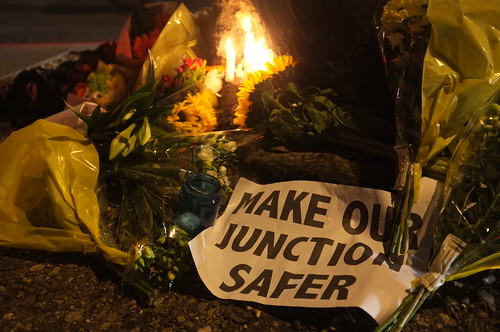
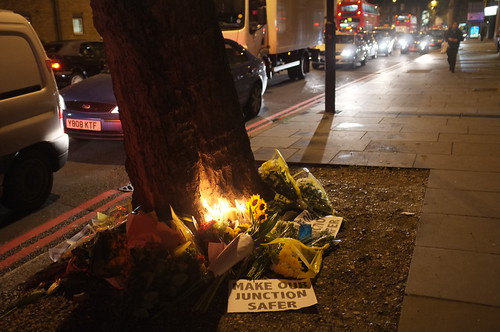
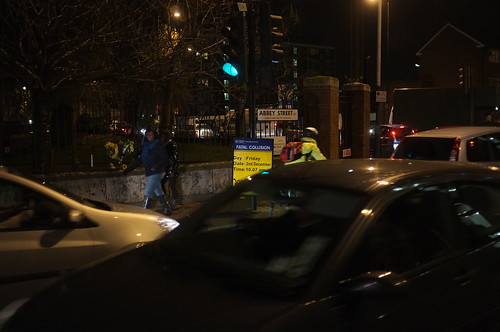
Flowers and candles for Ellie Carey, a 22-year old woman killed while cycling on Tower Bridge Road on 2 December 2011. The flowers and candles were left by family and friends on 14 December following a short vigil at the spot where she was killed by a left-turning heavy goods vehicle.
Ellie’s father Allister has led calls for the Mayor of London to step in and reduce the danger to all road users of a junction that has been the subject of safety campaigns by cyclists and pedestrians for at least two years. Politicians and campaigners are pressing the Mayor to take action to reduce road danger at many of London’s busy junctions. In response, the Mayor has promised a safety review of 300 junctions but remains committed to a policy of ‘smoothing traffic flow’ that precludes significant reengineering of layouts to give cyclists protected space on the roads.
2011 has seen 16 cyclists killed on the streets of London.
In the studio is Mustafa Arif, Chair of Campaigns at the 11,000 strong London Cycling Campaign. We look back at the weekend’s Tour Du Danger, a bicycle ride around ten of the most hazardous junctions for cyclists in London and hear how politicians Simon Hughes MP and London Mayor Boris Johnson plan to make London a cycling city.
If you can bear it, you can hear the full half hour of Boris Johnson being grilled by the London Assembly on cycle safety.
Following a spate of deaths and serious injuries to London cyclists, there is a growing campaign to make London streets safer for cycling and walking. Under questioning from various members of the London Assembly including Caroline Pidgeon and Jenny Jones, it appears the Mayor thinks that things are fine as they are.
This is a complete audio record of Boris Johnson answering questions on cycle safety on 10 November 2011.
Some people say that air pollution in big cities like London is a public health emergency, contributing to 4,300 premature deaths a year. But nobody seems to talk about it. Is the Government doing anything to deal with it? Are cyclists at risk more than other people?
Is the Mayor of London more concerned about avoiding fines from Brussels than cleaning up the air we breathe? And why is Boris trying to glue air pollution to the roads? Jack and Jen discuss the issue with experts Simon Birkett of the Campaign for Clean Air in London and environmental lawyer Alan Andrews of Client Earth.
More data and information including some amazing maps of air pollution in London are available from the London Air Quality Network.