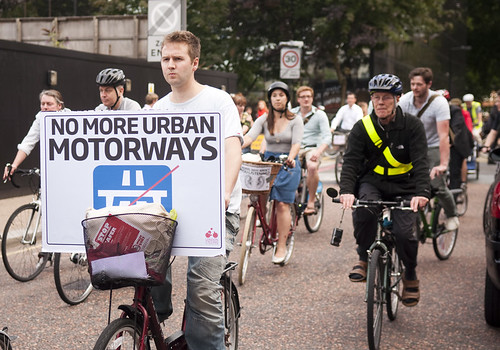
Team GB rules the track and Patrick Field tells it like it is

In this week’s show, Jack attempts to feign interest in the European track cycling championships and Jen gets her geography all confused. Patrick Field saves the day with an inspirational talk at the Intelligence Squared cycling festival (view more here). Plus details of the next Friends of the Bike Show ride on Sunday 6 November.

Compare and contrast

Here’s the Mayor and Transport for London’s plan for the new northern end junction of Blackfriars Bridge:

TfL's existing plan

And here’s the new plan from the London Cycling Campaign:

London Cycling Campaign's new plan

Which do you prefer?

If you think the LCC’s design is so much better, then get on your bike and join hundreds of London cyclists and walkers for a flashride at Blackfriars Bridge, tomorrow, Wednesday 12 October at 5.45pm. Simple as that.

Blackfriars and Beyond

Blackfriars Flashride

The ‘Battle for Blackfriars’ has united London cyclists and pedestrians in opposition to plans by the Mayor of London for an ‘urban motorway’ on a London bridge that is heavily used by cyclists yet has seen two fatalities in the past decade. Discussing the campaign for a better Blackfriars is blogger Mark Ames and Charlie Lloyd of the London Cycling Campaign. Andrew Boff, Conservative member of the London Assembly and the Mayor’s ‘ambassador for championing cycling’, shares his take on Blackfriars, London transport and the vexed question of who runs the city.

Photo credit: Joe Dunckley

Blackfriars Bridge: how far to push the limits of peaceful protest?

In the face of a unanimous motion of the London Assembly and the Mayor’s own misgivings, Transport for London plans this weekend to build a dangerous new gyratory on the north side of Blackfriars Bridge, a road scheme that has been criticised from all sides for putting the interest of private motor vehicles ahead of the pedestrians and cyclists who, taken together, will be the majority of the road’s users.

The Mayor’s ‘ambassador for cycling’ is Andrew Boff AM. He recently had this to say:

‘I am staggered that so many cyclists use Blackfriars Bridge, if it was on my commuting route I wouldn’t because it is too dangerous. I hope a full review of the new layout and speed limits on the bridge and the publication of all the relevant data will result in a sensible solution that will address the needs and safety of all users.’

Unfortunately TfL’s head of surface transport Leon Daniels has stuck up two fingers to Mr Boff and everyone else and are ploughing on ahead with the new gyratory.

Image credit: Crap Cycling and Walking in Waltham Forest

TfL’s contractors aim to have the job done by Monday, so as not to have works going on at the same time on Blackfriars and the neighbouring Waterloo Bridge. Waterloo Bridge is currently in the middle of six weeks of roadworks by British Telecom. As Leon Daniels says in the TfL press release:

‘In order to keep disruption to Londoners to an absolute minimum our contractor will be working 24 hours a day from the evening of 29 July to the morning of 1 August, thereby getting the work done in the shortest possible amount of time and avoiding clashing with other planned bridge works in central London.’

The Blackfriars Bridge flash rides planned for Friday night are all very well for expressing opinion but are unlikely to keep the bulldozers at bay. However, if sufficient riders were to linger awhile, say for 48 hours, until Monday morning, they might just prevent access to the site by TfL’s contractors. TfL would have to reschedule the work, rebook the contractors, and so on. The delay might mean the Mayor would take notice and do something, rather than just talk about making London better for cycling and walking.

Alternatively, if word got around that something was brewing, and the Mayor decided to bring in squads of Police to guard the bridge, it would become very apparent that he was heavy handing a situation in the face of overwhelming public and political opposition. That would not be very good PR.

It would require a significant number of people to be prepared potentially to put themselves in harm’s way, possibly sacrificing a few D-locks and risking arrest for obstruction of the public highway. A couple of months ago on the radio show Jenny Jones AM, the Green Party’s candidate for Mayor, said she hoped she would not have to resort to lying down in the road to prevent TfL’s scheme.

I guess we’ll see how strong opinion really is among London’s cyclists who are rapidly learning that in Transport for London, we have a formidable enemy.

Amendment to Motion on Blackfriars Bridge

This amendment to a motion tabled by Jenny Jones and Caroline Pigeon has been unanimously agreed by the London Assembly:

“This Assembly notes the decision to revert to a 30 mph speed limit on Blackfriars Bridge. We also note the recent decision of the Corporation of London to consider plans for the whole of the City of London to become a 20mph zone, and understand that if they take this decision they would be likely to ask Transport for London to agree to make TfL roads 20mph. This Assembly asks that the Mayor instructs TfL to implement a full review investigating the practicalities, advantages and disadvantages of a 20mph limit on Blackfriars Bridge.

The review should include previous TfL reports, such as that on 20mph speed limit on London’s Thames bridges and also the effect of such a change on all road users (including pedestrians) north, south or on the bridge itself.

Meanwhile, TfL should keep under review the decision to revert to a 30 mph speed limit on Blackfriars Bridge. We also urge the Mayor to revisit the plans for the bridge with particular attention to cyclists making right turns when exiting the bridge at either end.”

The original motion read as follows:

“This Assembly regrets the Mayor’s failure to retain the temporary 20mph speed limit on Blackfriars Bridge in the permanent new scheme for the bridge.

We note the recommendation for a 20 mph speed limit on four London bridges in a 2008 Transport for London report, and the recent decision of the Corporation of London to ask officers to bring forward plans for the whole of the City of London to become a 20mph zone, including TfL roads.

We ask the Mayor to reconsider his rejection of a 20mph limit on Blackfriars Bridge, in the interests of the safety of all its users.”

Hat tip: James Hatts

UPDATE:

Here’s the audio record of the debate, definitely worth a listen. Lots of nuance among the various contributions:

London Assembly debate on 20mph speed limit for Blackfriars Bridge by jackthur

Why Boris Johnson has got it wrong on Blackfriars Bridge

Is this an inviting experience for cyclists?

London’s Mayor Boris Johnson has made his position clear on Blackfriars Bridge, a subject that has become a major subject of campaigning for a more cycling-friendly city:

Question No: 1750 / 2011
John Biggs: Would you support a 20MPH limit throughout the junction?

Written answer from the Mayor, received on 13 July 2011:

A temporary 20mph limit was introduced at the junction of Blackfriars only to accommodate the construction of the station, which has required a great deal of hoarding, resulting in the narrowing of road space. It has been necessary to redesign the junction in order to accommodate new pedestrian crossings and the hugely increased pedestrian flows into and out of the station once it reopens. The two new crossings will reduce traffic speeds through the junction such that the additional signage and other infrastructure necessary to post a 20mph limit would be redundant and it would not be of benefit when traffic is lower during the remainder of the day.

There is no evidence that speed was an issue at Blackfriars prior to the current station works, with only one speed related collision recorded since 2006. Modelling demonstrates that speed will not be an issue after the scheme is built.

Modelling of the revised format shows that traffic will travel at less than 20mph for the morning peak, the period which coincides with the highest cycling demand. TfL will closely monitor traffic speeds through the junction and will take action if it becomes clear that speed is an issue.

(Emphasis added)

Dr Robert Davis of the Road Danger Reduction Forum came on the show a couple of week’s ago. One of his arguments is that public policy is heavily skewed by a form of ambulance-chasing, i.e. only taking action on road danger when there is evidence in the form of collisions causing death and serious injuries. By only responding to data on crashes, Dr Davis says we ignore the adaptive behaviour that is going on among vulnerable road users like cyclists and pedestrians. We are presented with the apparent paradox that a road can be dangerous for cyclists yet be declared ‘safe’ since there have been no crashes involving cyclists. This is because cyclists have simply decided not to ride on that road.

Now, nobody can say that cyclists are refusing to ride over Blackfriars Bridge. On the contrary, cyclists outnumber motor vehicles during the morning rush hour. However, they are a certain kind of cyclist – confident, assertive, experienced. And many of this confident minority would say that riding over the Bridge is something they do with gritted teeth.

If Blackfriars Bridge feels like a motorway, we can assume that a large number of potential cyclists are being discouraged from riding over it.

If we want cycling to become a truly everyday mode of transport, open to everyone and not just the confident, athletic minority, then we need to make key routes like London’s bridges more inviting to every cyclist, and every potential cyclist. And this means paying attention to issues of speed, space and potential sources of danger, not hiding behind statistics that are skewed by the adaptive behaviour of the most vulnerable. It requires a complete overhaul of the design. Is this something that a Mayor who’s top transport priority is keeping motorised traffic moving smoothly is likely to countenance? I doubt it, though I would love to be proven wrong.

Photo credit: Crap Cycling and Walking in Waltham Forest