Touring tip #3: Pump me up!

As a young cycle tourist in the late 80s and early 90s I used to get a lot of punctures. Fortunately, at that time the charts were full of tunes featuring lyrics about pumping this or that up and I was able to pass the time while fixing punctures by singing them to myself.

Pump it up a little more
Get the party going on the dance floor
See cos that’s where the party’s at
And you’ll find out if you’re too bad

These days, the recording industry seems a lot less occupied with pumping stuff up. This is because good quality modern bicycle tyres mean that we’re all getting far fewer flats. Yet a puncture remains a minor inconvenience for which every bicyclist should be prepared. Commuter cyclists can always jump on a train or hail a taxi to get home, but if you’re touring, you’re on your own.

Besides a couple of spare tubes and a repair kit, it is definitely worth carrying with a good pump so that you can get your tyres back up to the correct pressure. A minipump is a nice thing to find inside a Christmas cracker but you will find it very hard work to inflate your tyres to anywhere near high enough pressure using a minipump. The best pump for the touring cyclist is a frame mounted pump. Because it’s mounted securely on the frame, it’s always right there so you can keep your tyres topped up as necessary and it frees up some space in your bags for carrying flapjacks.

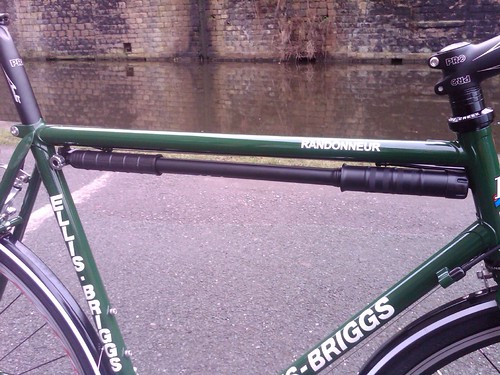
Frame pumps have a reverse spring action that keeps them firmly wedged in the frame, either along the top tube or the seat tube. I would recommend using a velcro cable tie (the stuff sold to gardeners is the best value) to ensure the pump is even more securely fastened to the frame, just in case it’s dislodged. While some manufacturers recommend mounting on the seat tube, this takes up space that could be used for a water bottle cage. So it’s usually best to mount the pump on the top tube, thus:

Ellis Briggs Randonneur Tiagra Brunswick Green with Zefal HPX pump

The best frame pump is made by Zefal. It’s the HPX model, made from aluminium, not flimsy plastic. It can reach a tyre pressure of 160 psi. As a touring cyclist you will never pump your tyres to anywhere near such a high pressure, but it’s good to know you’ve a pump with plenty of power in reserve. In the unlikely event that any part of the pump breaks, replacement parts are available.

There are lots of other pumps, but this is the best one. For some reason it’s now called the Zefal HPX ‘Vintage’ Frame Pump. I am taking this to mean vintage as in vintage champagne (i.e. better than non-vintage champagne), not vintage as in old-fashioned or retro. Mind you, the Zefal company has an impeccable retro lineage, having been making pumps since inflatable tyres were invented. The company even employed Tour de France stars Octave Lapize and Eugène Christophe as technical advisors. Eugène Christophe is one the greatest cycle tourists ever to have competed in the Tour de France. According to Jock Wadley,

He said not the first time during my visit that he was not a rich man in the monetary sense but had a wealth of happy memories and good health to show from his racing exertions. He still rides a lot, is at most of the touring rallies in the Parisian area, but likes to take it easy. ‘I have suffered enough on a vélo,’ he said, but last year he did 115 miles in 8½ hours, with 12lb of luggage, stopping 10 minutes every two hours to eat biscuits, pears and grapes and drink a glass of Vichy water.

The Zefal HPX comes in four sizes for different sized frames. Make sure you get the right one. At £20 this pump is less than half the price of a bottle of vintage champagne and less than a quarter of the price of certain other top end pumps. It’s a bargain.

Selected tracks from Jack’s pumping teenage jukebox:

Pump Me Up – Trouble Funk
Pump It Up – Elvis Costello & the Attractions
Pump Up the Volume – M/A/R/R/S
Pump Up the Jam – Technotronic
Pump, Pump – Snoop Doggy Dogg

Touring tip #2: the Lifeventure insulated mug

When you’re heading off on a cycle camping trip, you’ll need some kind of cup to drink from. Unless, of course, you prefer the rugged Bear Ghrylls drinking-from-waterfall-with-cupped-hands look or you take your inspiration from Ray Mears and prefer to fashion a sturdy and sustainable container for your beverage by weaving together a mess of dock leaves picked from the hedgerows.

But if you disregard the TV survivalists and get serious for a moment you’ll want to pay attention to this recommendation: if your intention is libation and you have an appreciation of insulation, there’s no better creation than… the Lifeventure thermal mug.

The merits of this mug were first demonstrated to me by Dixe Wills, a sturdy cyclist and author of the highly original and deliciously mirthful Places to Hide, as well as a very handy guide to Britain’s best tiny campsites. Dixe is a very moral man and a strict vegan. He won’t even drink a pint of beer unless he knows for certain it was brewed without the slightest harm to a sentient being. Before I met Dixe, I was ignorant of many things. I knew nothing of the Lifeventure insulated mug and I had know idea that some beer was vegan and some contained ground up sheep pancreas or some other unspeakable horror of industrialised food production. Spend a few days with Dixe and I’m certain you’ll learn many new things about the world. Alternatively, you can follow him on twitter.

Given his lefty leanings and vegan ways, I was somewhat surprised by the the eagerness with which Dixe told me the that very same Lifeventure mug as was cupped in his mitts is widely used by the British armed forces: a group not known for an anarcho-syndicalist Weltanschauung nor an aversion to violence (killing is part of the job description, after all). Anyway, Dixe told me that it’s common for soldiers to discard the crummy standard-issue Army drinking vessel and fork out for their own Lifeventure insulated mug.

If a piece of equipment meets with the approval of both a bicycling vegan who scrapes a living writing books about visiting tiny islands and towns and villages that begin with the letter Z and a bunch of tattooed hard nuts who scrape a living promoting peace and justice down the barrel of a gun in the Hindu Kush, then it must be worthy of consideration on any cycle tourist’s packing list.

So what does it do? Well, perhaps a better question is what it doesn’t do. It has a lid that doesn’t leak. It’s vacuum insulated so it doesn’t burn your hands. It’s made of stainless steel so it doesn’t break if dropped. Most importantly it will keep your  tea / coffee / hot chocolate / soup / hot toddy / mulled wine (delete as appropriate) hot for nearly half a day.

So how do I use it? Well, it goes something like this. When I’m camping I’ll usually boil some water first thing in the morning, perhaps to make some porridge and a hot drink, to have a shave or do the washing up from the night before. Call me a effete sophisticate but I draw the line a using the same water for washing up and shaving, though I imagine residual grease in the water could provide some additional lubrication for the shave and an interesting eau de cologne for the rest of the day. I’ll leave such antics to the TV survivalists.

It’s a trifle to fill my mug with a hot drink for later in the morning. A couple of hours down the road I’ll stop, sit myself down in a flower meadow, inna Laurie Lee stylee, dig a flapjack out from the deepest recess of my pannier and partake of the fine British tradition of elevenses, or as our Italian cousins call it, la merenda.

The Lifeventure insulated mug costs less than £10 and is available in no fewer than eleven colourways including the eye-catching US Navy Seals “Don’t Ask, Don’t Tell” Special Edition (pictured, right).

This post is part of an ongoing series in which I share what I’ve learned in half a lifetime’s cycle touring adventure and misadventure.

Touring tip #1: Why Ordnance Survey maps are best and how to get them for free

The British Isles are blessed with the world’s best maps for travel and adventure, made by the expert cartographers of the Ordnance Survey. There’s nothing like stopping by the side of the road, leaning your bicycle up against a dry stone wall and wrestling with a rapidly, uncontrollably unfolding paper map, like a waiter at a windy seaside restaurant fighting a losing battle with a large tablecloth. Eventually, you get the map under control, pinpoint your location and are filled with joy to discover that just a few yards away, in the field on the other side of the dry stone wall, is a neolithic hut circle!

Of course, proponents of the wiki-democratic Open Street Map loath the Ordnance Survey with a passion. It stands for everything they’re against: closed systems, the tyranny of the professional and paying for stuff. The Open Street Map is a marvel of internet technology and collective, volunteer action. In many ways, it is far more powerful than a paper map. But there is such a thing as too much information. And too little. On my travels I have found whole villages absent from OSM (I dutifully added them to the OSM database when I returned home).

If maps are works of art, I find the Open Street Map less attractive to look at and less easily comprehensible than an OS map. Open Street Map feels cold and computer-generated when compared to the subtle craft of the Ordnance Survey’s cartography.

Ordnance Survey Landranger Series (1:50,000)

Andy Allan's Open Cycle Map (a version of the Open Street Map), for comparison

More importantly, the Open Street Map is only available on a computer screen. Call me a Luddite but I like a nice, big paper map where I can gaze, like Gulliver in Lilliput, over an entire landscape laid out before me. With a computer map I get lost scrolling back and forward and zooming in and out. And once you’re on the road, what use is a computer map?

That’s all very well, I hear you say, if you’ve got deep pockets. It’s true, OS paper maps are expensive. OS Landranger maps are 40km x 40km, and an enthusiastic cyclist with a decent tailwind could well travel across a whole sheet in a single afternoon. At £6.99 (less on Amazon) the costs for a tour can mount up. Some might quibble that the optimum scale for the touring cyclist is 1:80,000 rather than the 1:50,000 of the OS Landranger series and they might have a point.

But help is at hand in the form of your nearest public library. Most keep a complete range of OS maps: both 1:25:000 (best for walking or for scoping out possible wild camping spots) and the more cyclist-friendly 1:50,000 as well as the somewhat rough-and-ready Touring Series. They’re usually the more expensive, laminated, weather-proof, fold-resistant versions too.

My local library allows me to borrow up to twelve maps for three weeks at a time. I can even renew them online. Even if you prefer to use a GPS device for navigating – and there’ll be a post on digital mapping and GPS to follow – for general route planning, there’s nothing like sitting down at a gigantic table in a library map room with a chaotic expanse of OS maps to make you feel like a real, bonafide adventurer. On a rainy day such as today, can there be any better way to prepare for a bicycle tour?

This is the first in a series of articles, tips and notes about cycle touring.

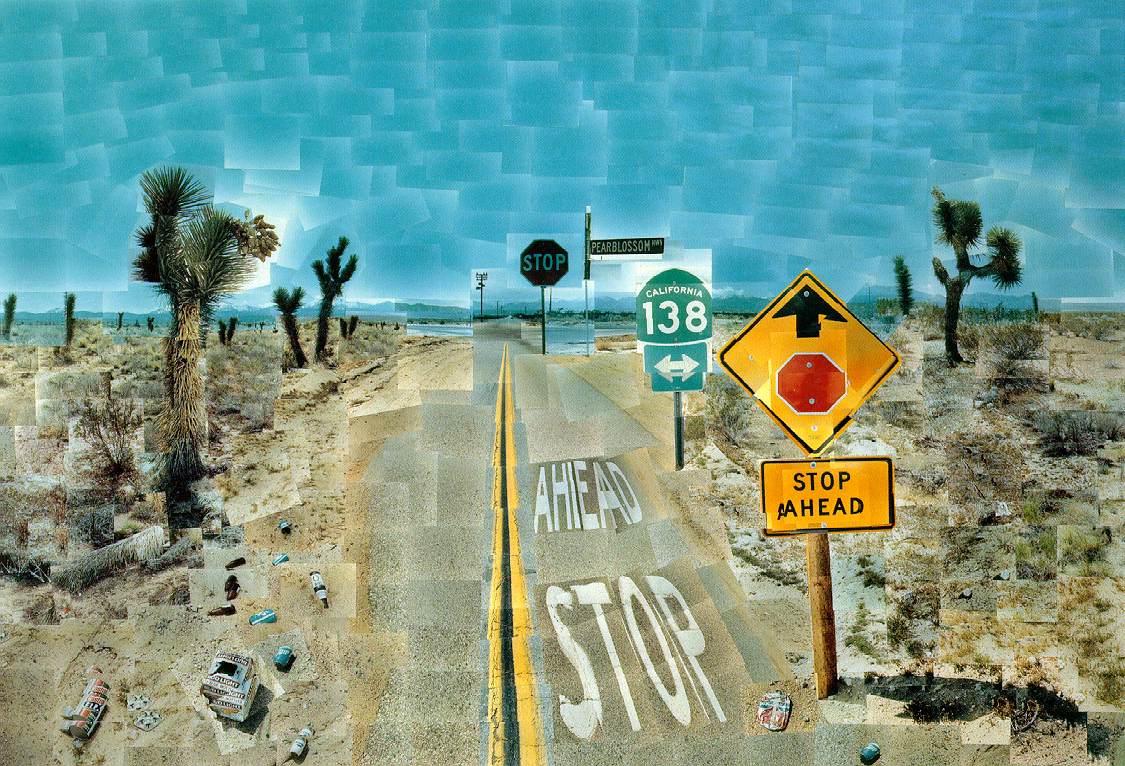
David Hockney, the Bigger Picture and the Aesthetics of Cycle Touring

“You road I enter upon and look around! I believe you are not all that is here;
I believe that much unseen is also here.”

Walt Whitman, Song for the Road

In one of the final rooms of the Royal Academy’s blockbuster exhibition of new work by David Hockney that closed earlier this week there was a video wall showing a series of short films that take Hockney’s 1970s and ’80s photo montages into the digital video age. Using arrays of 9 and 18 video cameras mounted to film a single scene simultaneously, Hockney was looking once again to break free from the single point of view and prescriptive framing that defines photography and film.

In a radio conversation with Andrew Marr, Hockney explains,

“In the end, the world doesn’t quite look like photographs. Cameras give you a certain kind of view, but it’s not quite the human view. With one camera, no matter what it’s like, however high definition it is, you’re going to have one perspective. You cannot escape that and however big you make the picture, it’s going to be same time in the far left corner and the far right. As your eye moves through it, it doesn’t see time. It can’t.”

In his photo montage and film works – as with his painting – Hockney is aiming to achieve a more immersive representation of reality and experience: A Bigger Picture, as the exhibition was titled.

One of the film pieces depicts a slow passage along a country lane. In the opening moments we see a pair of cyclists ride towards the camera array, and past it, behind us. Apart from two film pieces filmed in his studio and featuring Hockney, several of his friends and small corps of ballet dancers, this pair of cyclists on the country lane are the only people depicted in the entire exhibition. We must assume that there is an element of intention here for Hockney’s sometimes flamboyant persona belies a hard grafting master of technique and detail. For me, it seems entirely appropriate as the whole of A Bigger Picture spoke to my experiences as a cyclist – as a cyclotouriste – in ways that I found joyful and uplifting.


Photograph above by Rich Cousins

In the same conversation with Andrew Marr, Hockney talks of moving to the East Yorkshire Wolds having lived for three decades in southern California. It was a homecoming for this is where Hockney grew up and where he had spent thirty Christmases, back from Los Angeles to visit his mother who lived in Bridlington, on Yorkshire’s North Sea coast. Hockney recalls his life as a teenager cycling to and from work along the lanes that have been the subject of his most recent work and are the main subject of A Bigger Picture.

“I worked on a farm. I cycled around here for two summers. I used to cycle up to Scarborough, Whitby, a long way actually. You get to know it, and you know it’s hilly if you’re cycling. I was always attracted to it. I always thought it had a space. One of the thrills of landscape is that it’s a spatial experience.”

He’s no longer riding a bike, but I think he is recalling how the particular sensual, rhythmic experience of travelling in a landscape by bicycle – the kinaesthetic qualities of bicycle travel – contributes to the cyclotouriste’s appreciation of the character and meaning of particular places.

Cycling is a functional mode of everyday transportation but it is also a pastime. Driving a car for pleasure (‘motoring’) was once a common pastime but is increasingly rare. People drive with a purpose or destination in mind. Hockney’s own reacquaintance with the East Yorkshire landscape was through a period of daily car journeys to visit a terminally ill friend. Any enjoyment of the journey is largely incidental to getting from here to there. It’s not hard to see why. Drivers are confined behind the wheel, encased in a small metal box, removed from the elements. Their view is framed and constrained by the windscreen and anyway modern cars travel at speeds that allow only the most fleeting appreciation of the surroundings.

It is by walking (and perhaps swimming) that we achieve the most intimate connection with nature and of place, yet when walking or swimming it is difficult to cover much distance or to experience the changing shape and character of the landscape, to experience it as it unfolds around us. The bicycle is perfect for plugging into the Bigger Picture. A cheap, light, noiseless machine that affords total immersion in our surroundings and enables us to cover relatively large distances with minimal effort. The chief drawback compared to walking is that the cyclist is more confined to roads and byways, whereas the walker has the most freedom to roam at will (especially if prepared to trespass).

The road is a familiar Hockney motif and it is a near constant in these paintings. Roads that twist and turn in extravagant loops, roads that roll cheerfully across the landscape, dipping behind hills and returning to crest the next ridge. Roads that travel through woods, arched over by trees that form arboreal tunnels in which light and dark stripe the tarmac surface. These are roads with personality, even down to their surface which is carefully observed and rendered. In the small number paintings where the road is unseen it is clear that the landscape is being viewed from the road, looking out across a hedgerow or or verge rich with foliage and star-spangled with cow parsley. These are roads where you are unlikely to see many cars. Roads along which cyclists like to ride.

Hockney’s Tunnel series presents the same view of a single green lane lined by trees on each side at different times of year. With its thick grass mohican running down the centre it’s easy to picture a lane like this on any countryside ride.

Like Hockney, the cyclist returns to the same lanes, noticing the changes in the season, the weather, the time of day, variations in light and vegetation. After some years the cyclist would really know that lane very well. It is exciting to adventure into a new places, and ride along untravelled roads, but what cyclists most often find themselves doing is returning to the same places, the same roads, over again. New places can be thrilling, but familiarly can bring with it a deeper understanding and affection for a place.


Photograph above by Simon @ the Unofficial Hockney Trail

After three decades abroad, Hockney has returned to the countryside of his youth, bringing with him the dramatic light and shade and sublime, super saturated pigments of the American West. Along with his gift for composition he puts this luxurious palette to work in rendering the English countryside in a bold new light that is unexpected yet I think utterly faithful to the lived experience of total immersion in the landscape.

The colours, shapes and textures of the English countryside are as exciting as those in southern California or anywhere else in the world. Vast, constantly changing skies, clumps of acid green euphorbia, deep red beech forests, an iridescent woodland carpet of bluebells, banks of hot pink willowherb and perhaps most spectacular of all, the hawthorn blossom that erupts between the coming of spring and the early summer. Hockey dubs this ‘Action Week’, a reference not just to the growth in the hedgerows but to his own relish at being out there and painting them.

This time of year is startling to behold and Hockney brings passion and excitement to his canvasses, to the point of putting off many of the critics. No doubt, it is an escapist, optimistic, romantic vision of the countryside. But I think it is quite honest and no more sentimental than he means it to be. Hockney pastoral. There are no off-motorway distribution centres, fly-tipped rubbish, wind turbines, ‘luxury home’ developments or industrial farming paraphernalia. He is not drawn to the hallmarks of the Edgelands or the Unofficial Countryside beloved of contemporary psycho-geographers. There’s nothing wrong with Iain Sinclair stalking around the semi-derelict industrial estates of the periurban fringe and taking pleasure in their toxic trades, but that’s not what Hockney’s work is about. It’s about experiencing the relentless forces of nature, observing the shapes and colours of the vistas and plant forms and embracing the simple joys of being out there in the wind and the sun and the snow and the rain, the owls and the bats and the blossom and the bees, the trees and the leaves and the fields and the streams. All of which still exists in every corner of this island, no matter what anyone says about concreting over the countryside. It makes me want to get on my bike and ride.

All images are copyright David Hockney (except where otherwise noted) and reproduced for purposes of criticism or review in accordance with Section 30 (1) of the Copyright, Designs and Patents Act 1988.

On Two Wheels in France

Photo credit: Jack Thurston

As governments around the world seek to improve conditions for cyclists, we take a look at France, a country synonymous with cycle sport but that has a lot of catching up to do when it comes to everyday cycling. From Paris, Kieron Yates reports about cycling in the French capital and the new measures the national government is introducing to improve conditions for people on bicycles. And Gregory Bossuyt tells of leaving Paris behind him and taking to his bicycle in search of a new life in a new town.

For more information on the Big Ride on 28 April, head over to the London Cycling Campaign. And if you fancy joining other friends of The Bike Show for the Oyster Run on 14 April, there are more details over here.

Raphaël Krafft: reportage on two wheels

Raphaël Krafft is a radio journalist working for the French national broadcaster who for the past ten years has been finding his stories by bicycle. Krafft’s two wheeled reportage has taken him around Latin America, the Middle East, the French West Indies and on several occasions his own country, which he has toured during presidential election years, to find out what France really thinks.

Kieron Yates visited Raphaël Krafft in Paris for this extended profile, which features audio material from his radio broadcasts.

You can follow Raphaël and Alexis on their current trip La Campagne à Vélo.

Across Europe by Bike

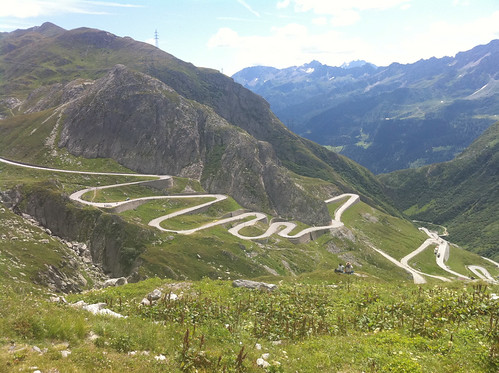
The St Gotthard Pass

Andrew Sykes tells of his six week summer journey from his home in Reading in Berkshire to Puglia, on the southern tip of Italy, along the Eurovelo 5 long-distance cycle route. He reads from Good Vibrations: Crossing Europe on a Bike Called Reggie, the book he’s written about the trip. Andrew will be appearing at Blue Door Bicycles this Wednesday 15 February at 8pm for a book reading and discussion.

Jen and Jack talk about the terror of the Waterloo bridge roundabout and the Mayor’s plans to remake it (again). Finally, a tribute to Henry Warwick, a veteran London bicycle messenger who was killed in a crash with a coach while working earlier this month.

Find out more about the Resonance FM fundraising auction.

Or just donate right now. The first 20 donations in excess of £10 (UK), €15 (Europe) and $20 (rest of the world) will get a Bike Show screen print by Richard Mitchelson.

Photo credit: Andrew P. Sykes